


Why are pollinators important?
Let's take a look at why insects, and specifically insect pollinators, are so important not only for the reproduction of plants but also because of their impact on ecosystems and on us, as humans.
There are some pollinating bird and bat species that have evolved specialized structures that help them live in symbiosis with flowering species, however, they are being excluded from this post for simplicity.
Insects, in general, provide valuable ecological services. These services include pest and parasite control, nitrogen volatilization, and, of course, pollination: it has been estimated that native pollinators are responsible for nearly $4 BILLION dollars worth of fruit and vegetable production in the United States alone (Losey & Vaughan, 2006).
Globally, however, it is estimated that 35% of crop production depends on animal pollination (Nicholls & Altieri, 2012), and in crops used for human consumption, the global economic contribution of pollinators is estimated to be around $162 billion USD (Gallai, Salles, Settele, & Vaissière, 2009).
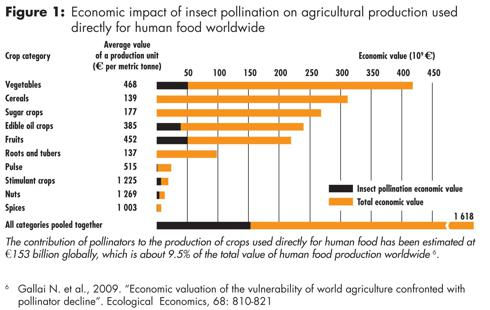
The rate of vulnerability in the face of a total loss of pollinators has been estimated to be about 9.5% of global agricultural production (Gallai et al., 2009).
In this situation, it should be noted that not all crops would be affected equally - the production of stimulant crops (such as coffee and cocoa), followed by nuts, fruits, and vegetables are more dependent on animal pollinators than other crops such as cereals and tubers (Gallai et al., 2009), and therefore the production of some crops would decrease at a much higher rate than others.
The World Health Organization recommends a minimum consumption of 400g of fruits and vegetables per day, and an insufficient intake of nutrients from fruits and vegetables is associated with an increase in the occurrence of preventable diseases (WHO, 2017).
Overall, a nearly 10% loss in global agricultural productivity would mean that the quantity of some crop types would fall below the current levels of global consumption, leading to malnutrition and malnourishment in some regions (Gallai et al., 2009).
To sum up those statistics:
Animal pollinators contribute big bucks to local and global economies
Animal pollinators help fertilize plants, which stimulate them to grow and produce fruits and seeds among other edible structures
We, as humans, like to eat - and all of the food we eat either originates from or depends on plants as it grows.
We need animal pollinators to help grow our food so that we can eat, stay healthy, and survive
Unfortunately, while native bees and honeybees are responsible for a majority of crop pollination (Losey & Vaughan, 2006), their populations are in decline - along with other native pollinators such as monarch butterflies. And, as we’ve already seen, there are both economical and public health implications of a decline in pollinator populations.
Gallai, N., Salles, J., Settele, J., & Vaissière, B. (2009). Economic valuation of the vulnerability of world agriculture confronted with pollinator decline. Ecological Economics, 68(3), 810-821. http://dx.doi.org/10.1016/j.ecolecon.2008.06.014
Losey, J., & Vaughan, M. (2006). The Economic Value of Ecological Services Provided by Insects. Bioscience, 56(4), 311. http://dx.doi.org/10.1641/0006-3568(2006)56[311:tevoes]2.0.co;2
Nicholls, C., & Altieri, M. (2012). Plant biodiversity enhances bees and other insect pollinators in agroecosystems. A review. Agronomy For Sustainable Development, 33(2), 257-274. http://dx.doi.org/10.1007/s13593-012-0092-y
WHO | Promoting fruit and vegetable consumption around the world. (2017). Who.int. Retrieved 15 April 2017, from http://www.who.int/dietphysicalactivity/fruit/en/
Comments